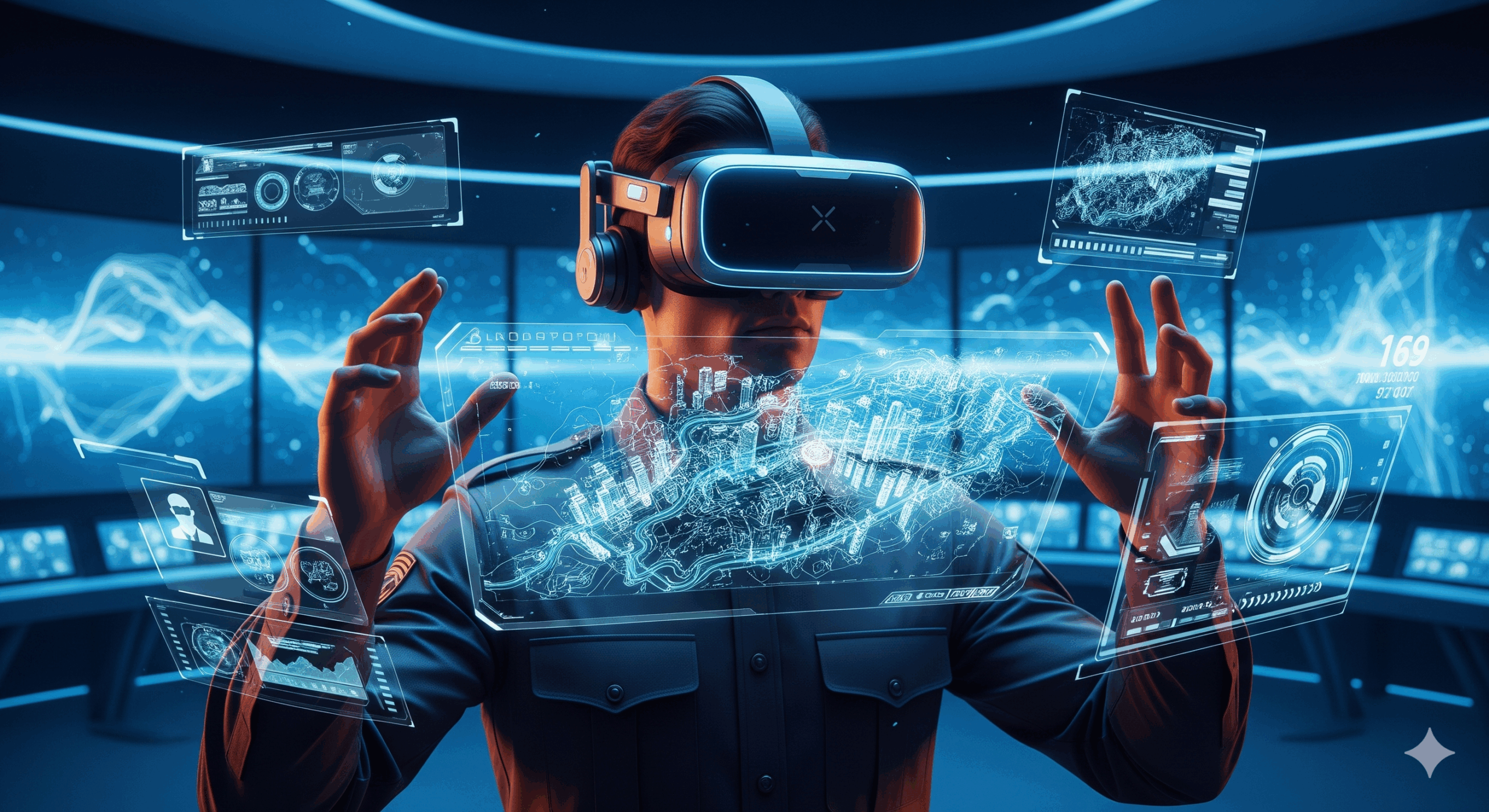
What if the next generation of soldiers, doctors, pilots, and engineers never needed to step into a real battlefield, operating room, cockpit, or control room to master their skills? What if governments could simulate every high-risk scenario, war zones, medical emergencies, and cyberattacks, without putting a single life in danger?
This isn’t a glimpse into tomorrow. It’s already happening. And the technology behind it is Extended Reality (XR) for Training.
From classified military simulations to immersive medical procedures, governments around the world are quietly deploying XR to reshape how they train their workforce. But why now? What’s driving this global shift? And what does it mean for the future of public service, safety, and national readiness?
In this blog, we’ll uncover the hidden strategies behind XR adoption, explore its real-world applications across sectors, and reveal why Extended Reality (XR) for Training is becoming the backbone of modern governance. The answers may surprise you, and they’re changing everything.
Understanding XR: The Technology Behind Transformation
According to the U.S. Government Accountability Office (GAO), Extended Reality (XR) for Training blends digital environments with physical interactions, creating highly immersive, interactive learning experiences. These tools are increasingly used for:
- Technical education and vocational skills
- Emergency management simulations
- Medical instruction and therapy
- Cybersecurity drills and mission readiness
Extended Reality (XR) for Training utilizes wearable displays, advanced sensors, and connected ecosystems to deliver realistic scenarios. Whether it’s full immersion (VR), digital overlays (AR), or hybrid interactions (MR), this technology is reshaping how public institutions approach upskilling and workforce preparedness.
Defense Sector: Building Tactical Advantage with XR
The U.S. Department of Defense (DoD) has declared Extended Reality (XR) for Training a priority area, emphasizing its role in mission planning, soldier readiness, and maintenance training. The Office of the Under Secretary of Defense for Research and Engineering is investing in XR-based human-machine interfaces that support everything from field tactics to flight simulations.
Key Initiatives include:
- 5G-Enabled XR Environments: Trials at Joint Base Lewis–McChord and San Antonio are enabling low-latency XR applications for live, distributed combat simulations.
- Virtual Training Hangars: The U.S. Air Force is developing digital aircraft environments for “anytime, anywhere” maintenance training.
- Global Maintenance Support: The Navy is leveraging Extended Reality (XR) for Training to connect technicians worldwide, improving real-time diagnostics and collaboration.
These efforts not only enhance operational readiness but also allow the military to conduct cost-effective training in complex, high-risk environments.
Energy Sector: XR-Driven Workforce Readiness
In the high-stakes world of energy, training precision isn’t optional; it’s essential. At Sandia National Laboratories, Extended Reality (XR) for Training is revolutionizing how operators are prepared to handle the Z Machine, the most powerful radiation generator on the planet. Through an immersive framework that demonstrates, teaches, evaluates, and synthesizes, XR empowers new hires to learn complex procedures faster and with fewer errors, while also capturing the deep knowledge of veteran technicians.
As the energy sector grapples with growing labor shortages and critical skills gaps, XR offers a scalable, safe, and efficient alternative to outdated, resource-heavy training methods. Whether it’s simulating hazardous operations or enabling remote practice, Extended Reality (XR) for Training ensures continuous learning without the real-world risks. In this demanding field, XR isn’t just enhancing training; it’s future-proofing the energy workforce for the challenges ahead.
Aviation Sector: Safety Through Simulation
The Federal Aviation Administration (FAA) is another leader in adopting Extended Reality (XR) for Training, particularly for cabin crew and flight operations. FAA-led studies show that immersive simulations significantly improve response times and procedural accuracy during in-flight emergencies.
Benefits of XR for aviation include:
- Simulated evacuations and fire drills
- Realistic equipment handling
- Passenger interaction training
Because of its ability to simulate rare or dangerous events, Extended Reality (XR) for Training is becoming a key element in airline safety protocols and regulatory compliance programs.
Healthcare Sector: Immersive Learning for Medical Excellence
Through the VA Immersive initiative, the U.S. Department of Veterans Affairs is deploying Extended Reality (XR) for Training to enhance care delivery and medical education. Surgeons use MR for preoperative planning, while therapists use VR for rehabilitation and mental health treatment.
Applications include:
- 3D anatomical modeling
- VR-assisted psychotherapy
- Immersive training for medical students and nursing staff
With healthcare facing rising complexity and an aging population, Extended Reality (XR) for Training ensures that providers can learn and adapt quickly without compromising patient safety.
Education and Workforce Development: Inclusive Innovation
The U.S. Department of Education is advocating for Extended Reality (XR) for Training as a tool to promote equity and access in career and technical education. XR enables remote learning opportunities in underserved communities and supports learners with disabilities through adaptive interfaces.
Key Highlights:
- Democratizing access to high-tech skills
- Bridging geographic and social divides
- Supporting lifelong learning and retraining initiatives
Extended Reality (XR) for Training is helping to close the digital divide while also preparing the next generation of workers for high-demand fields like cybersecurity, AI, and advanced manufacturing.
Global Government Momentum: XR as the New Norm
Internationally, governments are embracing Extended Reality (XR) for Training to modernize how they deliver education, emergency response, and public service readiness. Key advantages include:
- Scalability: Train large workforces across geographies simultaneously
- Safety: Simulate hazardous or sensitive scenarios without real-world risk
- Efficiency: Reduce physical infrastructure and resource dependency
As digital ecosystems mature, more governments are adopting Extended Reality (XR) for Training as a foundational component of workforce development and operational resilience.
Challenges and Future Outlook
Despite its transformative potential, Extended Reality (XR) for Training faces a series of formidable challenges that could slow its momentum. Cybersecurity threats loom large, as XR systems collect sensitive biometric and behavioral data, making them prime targets for breaches. Privacy concerns and data governance must be addressed before XR can scale securely. Hardware limitations, such as bulky headsets and high costs, also hinder widespread adoption, especially in resource-constrained regions.
Moreover, XR thrives on ultra-fast connectivity, and without robust 5G or fiber infrastructure, immersive training can falter. Perhaps the most overlooked hurdle is content creation; governments need skilled developers who can build realistic, pedagogically sound XR experiences. Yet, despite these obstacles, the future remains bright.
With rising public investment, regulatory support, and proven pilot programs, XR is on track to become a cornerstone of government training. The question is no longer if XR will dominate; it’s how soon it will redefine public sector learning.
Related article- Apple AR Glasses Blend Fashion with Futuristic Tech
Conclusion: A New Era of Government Training
The rise of Extended Reality (XR) for Training marks a defining moment in how governments prepare their workforce for the future. No longer confined to pilot programs or experimental labs, XR is now embedded in real-world operations, from virtual hangars in the Air Force to immersive surgical suites in the VA and smart classrooms in vocational institutes. This isn’t just a technological upgrade; it’s a paradigm shift in public sector capability-building.
As innovation accelerates and cross-sector collaboration deepens, XR is poised to become the backbone of government training strategies. It empowers agencies to train faster, safer, and smarter, while adapting to the evolving demands of a digital-first world. Governments that embrace XR today aren’t just solving present-day challenges; they’re laying the foundation for a more agile, resilient, and future-ready public service.
The question isn’t whether XR will shape the future of training; it’s how far ahead early adopters will be when it does.
About the Author