Pune, India | December 03, 2025
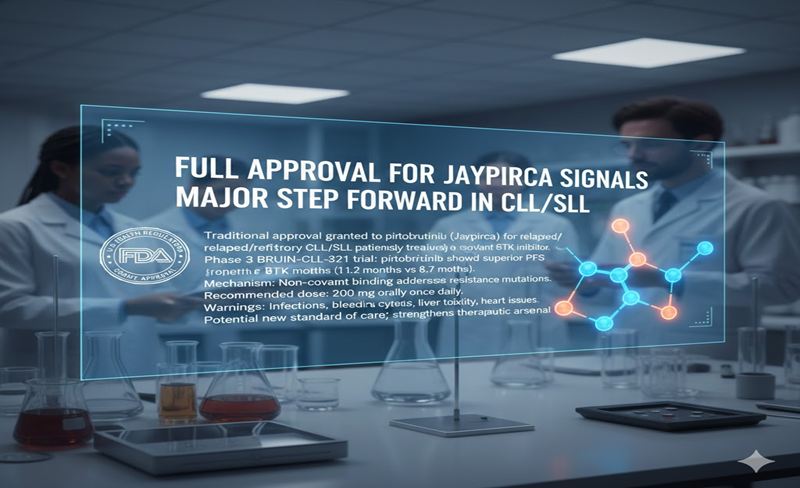
U.S. health regulators granted traditional approval to pirtobrutinib, commercially known as Jaypirca, for adults with relapsed or refractory chronic lymphocytic leukemia (CLL) or small lymphocytic lymphoma (SLL). Patients had previously received a covalent BTK inhibitor. This decision elevates prior accelerated approval to a formal, defined indication. It marks a significant milestone in the treatment landscape.
The approval is based on results from the Phase 3 BRUIN-CLL-321 trial. In this randomized study, 238 patients who had prior covalent BTK inhibitor exposure were assigned to pirtobrutinib or a physician-selected standard therapy. Standard options included idelalisib plus rituximab (IR) or bendamustine plus rituximab (BR). Primary analysis showed a median progression-free survival (PFS) of 11.2 months for pirtobrutinib versus 8.7 months for IR/BR. The hazard ratio of 0.58 indicates a 42% lower risk of disease progression or death with pirtobrutinib.
With a median follow-up of nearly 20 months, overall survival (OS) did not differ significantly between groups (hazard ratio 1.09). Yet, the PFS advantage highlighted meaningful improvement in disease control. This supports a clinically relevant delay in progression for patients whose disease relapsed or became refractory after prior BTK-targeted therapy.
Mechanistically, pirtobrutinib differs from older BTK inhibitors by binding non-covalently, or reversibly, to its target. Covalent inhibitors bind irreversibly, which limits activity when resistance mutations occur. In contrast, pirtobrutinib retains efficacy even against mutated cancer cells. As a result, clinicians now have a potent tool to manage patients progressing after prior BTK inhibition.
The standard dosing is 200 mg orally once daily. Therapy continues until progression or unacceptable toxicity arises. While efficacy is clear, prescribing information includes important warnings. Risks include serious infections, bleeding, cytopenias, liver toxicity, heart rhythm abnormalities, and possible secondary cancers or embryo-fetal harm. Physicians must monitor patients closely. These concerns are familiar for BTK inhibitors, but broader use requires heightened vigilance.
Full approval expands treatment options for CLL/SLL, especially for patients lacking effective therapies after covalent BTK inhibitors. Experts see Jaypirca as a potential new standard of care. Its activity, despite resistance mutations, may delay or reduce treatment resistance. This could improve long-term disease control in relapsed CLL/SLL patients.
This approval also represents a milestone. It is based on the first Phase 3 randomized trial exclusively in patients previously treated with covalent BTK inhibitors. Such rigorous evidence may drive wider adoption. Clinical guidelines may also be updated to reflect these results, boosting confidence among clinicians and patients.
Transitioning from accelerated to traditional approval marks significant progress for adults with relapsed or refractory CLL or SLL. With improved PFS, convenient oral dosing, and a mechanism addressing resistance, Jaypirca could become central therapy. Still, careful monitoring and thoughtful clinical judgment remain essential to balance benefits and risks.
Post-approval studies and pharmacovigilance will clarify Jaypirca’s real-world role. Health systems must consider patient access, coverage, and supportive care integration. The broader implication is a nuanced, resilient approach to relapsed CLL/SLL. Reversible BTK inhibition can sustain disease control where prior therapies failed.
Ultimately, traditional approval of pirtobrutinib reflects progress against a historically challenging disease. By extending PFS, preserving quality of life through oral administration, and offering resistance-targeting mechanisms, Jaypirca strengthens the therapeutic arsenal. Clinicians and patients will watch long-term outcomes and guideline updates closely. This approval establishes Jaypirca as a meaningful option for adults who have exhausted covalent BTK inhibitors.
About the Author