Over the past few years, India has witnessed a remarkable surge in tobacco exports, a trend that has lifted farmer incomes, boosted national revenues, and sparked fresh debates about sustainability and market risks. Below, we explore how this boom unfolded, who gained, and why challenges now threaten both export momentum and the livelihoods tied to tobacco farming.
From Local Farms to Global Markets
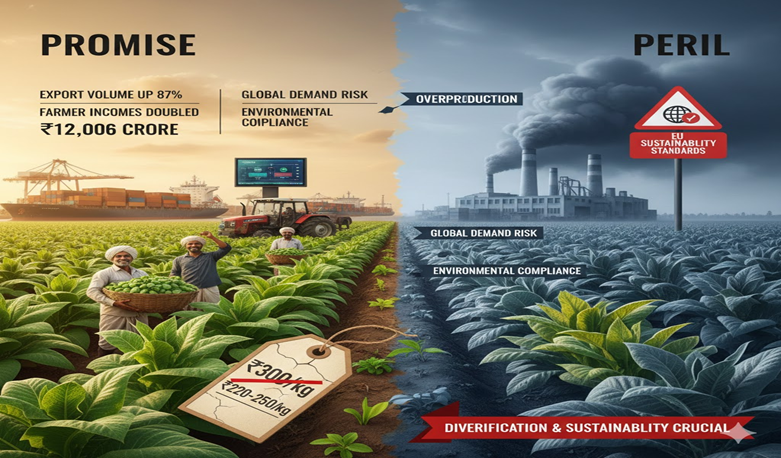
In the fiscal year 2023–24, India exported around 315.5 million kilograms of unprocessed tobacco, up from 218.8 million kilograms in 2019–20. That export volume brought in a record ₹12,006 crore (roughly US$1.45 billion), an 87% increase over five years.
Much of this growth has come from Flue-Cured Virginia (FCV) tobacco, the variety especially favored in international cigarette markets. FCV’s rising global demand turned it into India’s most valuable export crop.
As a result, many farmers who once sold tobacco locally at modest prices now supply leaves to a global supply chain reaching destinations from Belgium and the UAE to Singapore and Russia.
Farmers’ Gains: Income Doubled
For tobacco farmers, the surge in export demand translated directly into income growth. Between 2019–20 and 2023–24, the average price for FCV tobacco nearly doubled: from ₹124 per kg to around ₹279.54 per kg.
This effectively more than doubled many farmers’ revenues, enabling improved livelihoods, greater financial security, and reduced pressure to migrate or diversify away from marginal crop lands.
For regions where FCV thrives, often semi-arid lands unsuitable for many other crops, tobacco became a dependable cash crop.
Government Policies & Institutional Support
The export boom did not happen by accident. Several policy and institutional measures helped:
- The regulatory body Tobacco Board, extended support to growers through better quality standards, e-auction systems, and welfare schemes.
- Through duty-drawback schemes, discounted export credit, and incentives under the Interest Equalization Scheme, exporters got competitive advantages, which filtered benefits back to farmers.
- Modern practices and transparent auctioning helped ensure better price realization and reduced exploitation or middleman losses.
As a result, tobacco exports contributed significantly to foreign exchange earnings while offering small and marginal farmers a relatively stable income source.
Beneath the Bright Numbers: Risks and Emerging Crises
Despite the apparent success, the booming tobacco export story conceals deeper issues, many of which are now surfacing.
First, overproduction has created market saturation. In some areas, production exceeded authorized limits. Farmers anticipated high prices, but oversupply caused prices to fall drastically. For instance, many expected ₹300 per kg, but ended up selling between ₹220–₹250 per kg.
Second, global demand, especially from major buyers like the countries in the European Union (EU), may face disruption soon. New and strict sustainability standards, part of the EU’s drive toward carbon neutrality, are expected to make tobacco imports from countries like India more difficult.
These standards demand traceability, environmental compliance, and possibly carbon-neutral supply chains, requirements that many producers and processors in India may not currently meet.
If Indian tobacco fails to meet such standards, demand from key global buyers could drop sharply, threatening exporter margins and, by extension, farmer incomes.
Third, heavy dependence on raw tobacco rather than value-added products limits long-term stability. Currently, much export revenue is still coming from unprocessed leaves, making the sector vulnerable to commodity-price swings.
What This Means for the Future
For the tobacco export boom to endure, stakeholders must address structural challenges, not just celebrate export statistics. Here are key areas that need focus:
- Diversification: Farmers and exporters should gradually shift toward value-added products (e.g., cut-rag, nicotine extracts, processed tobacco) rather than only raw leaves. This can buffer them against raw-leaf commodity swings.
- Sustainability compliance: To retain access to markets like the EU, cultivation and processing practices must evolve, including environmental standards, traceability, and possibly carbon-neutral supply methods.
- Market regulation & production planning: Overproduction must be avoided. Proper crop planning and tighter regulation might prevent price crashes. Institutional support should include real-time demand assessment and supply coordination.
- Farmer support & alternate livelihoods: Given global shifts in anti-tobacco policies, sustainability pressures, and consumer health trends, farmers should be supported to diversify into alternate crops or allied livelihoods.
Conclusion
India’s tobacco export boom has undeniably created a success story, transforming tobacco from a modest local crop to a high-value global export. Farmers reaped tremendous benefits, and export revenues soared. However, beneath those gains lie serious vulnerabilities: oversupply, price volatility, and the looming challenge of stricter global sustainability standards. Unless policymakers, exporters, and farmers act strategically, embracing diversification, quality, and sustainable practices, the current boom might not last. In many ways, the future of India’s tobacco sector hinges less on how much is harvested and more on what is exported and how.
About the Author