Pune, India | December 02, 2025
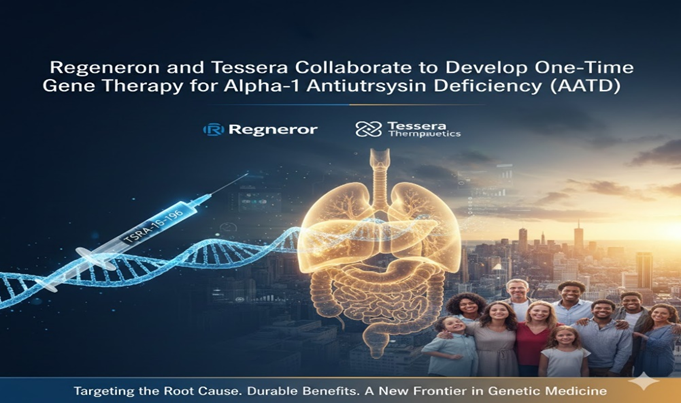
Regeneron Pharmaceuticals and Tessera Therapeutics recently announced a strategic collaboration to co-develop TSRA-196, a one-time gene-writing therapy aimed at treating Alpha-1 Antitrypsin Deficiency (AATD). Under this agreement, Regeneron will provide $150 million upfront in cash and equity to support Tessera’s research and development. In addition, Tessera could earn up to $125 million in near- and mid-term milestone payments as TSRA-196 advances through regulatory and development stages.
The agreement states both companies will share development costs and future profits equally. Tessera will lead the initial first-in-human clinical trial, while Regeneron manages global development and commercialization efforts. This collaboration combines Tessera’s expertise in gene-writing technology with Regeneron’s deep experience in clinical development, regulatory affairs, and worldwide commercialization. Together, they aim to efficiently bring TSRA-196 to patients across the globe.
TSRA-196 targets the underlying genetic mutation in the SERPINA1 gene responsible for AATD. By repairing this mutation, the therapy seeks to restore normal Alpha-1 Antitrypsin (AAT) protein production. If successful, it would replace current weekly augmentation treatments with a single durable therapy that addresses the disease’s root cause. This one-time treatment has the potential to improve patients’ quality of life while reducing long-term treatment burdens drastically.
Preclinical studies revealed promising results for TSRA-196. Experiments with mice and non-human primates demonstrated that just one dose enabled durable, precise editing of the SERPINA1 gene. Importantly, the editing focused mainly in the liver—the primary site for AAT production—and avoided off-target or germline changes. Moreover, the therapy showed a favorable safety profile and was well-tolerated in these models. Such findings support advancing TSRA-196 into human clinical trials.
Alpha-1 Antitrypsin Deficiency is a rare inherited disorder affecting the lungs and liver. Mutations in the SERPINA1 gene cause abnormal AAT protein to accumulate in the liver, which may lead to inflammation, fibrosis, or cirrhosis. Simultaneously, insufficient functional AAT in the bloodstream leaves lungs vulnerable to progressive damage, often resulting in COPD or emphysema. Currently, no approved therapies correct this genetic defect, and treatments mainly relieve symptoms while requiring frequent intravenous infusions. This frequent dosing imposes a substantial burden on patients.
The companies plan to submit an Investigational New Drug (IND) application to the U.S. FDA and multiple international clinical trial applications by the end of 2025. Once approved, the first-in-human trial will assess the therapy’s safety, tolerability, and initial efficacy in adults with severe AATD. Should these trials prove successful, later studies will enroll larger patient populations and monitor long-term outcomes, paving the way to global commercialization.
Executives from both organizations expressed optimism regarding this collaboration. Regeneron highlighted genetic medicine’s transformative potential to address previously untreatable conditions. Similarly, Tessera noted that TSRA-196 could revolutionize AATD treatment by delivering a single intravenous dose with durable benefits. This partnership reflects a shared commitment to innovation, patient-centric research, and advancing next-generation genetic therapies.
Despite this significant milestone, the agreement is still subject to customary closing conditions, including regulatory approvals and antitrust reviews. Both companies will also increase investments in further research, manufacturing scale-up, and clinical infrastructure. These efforts aim to ensure the efficient availability of TSRA-196 to patients once approved. By sharing expertise and resources, Regeneron and Tessera expect to accelerate development timelines and maximize the therapy’s potential impact.
This collaboration marks an essential step toward the first gene-writing therapy for AATD. If TSRA-196 proves safe and effective in clinical trials, it can redefine treatment by offering a long-lasting, one-time intervention that corrects the disease’s genetic cause. This breakthrough could bring hope to thousands of patients worldwide who currently face limited treatment options.
Both companies have expressed a long-term commitment to exploring Tessera’s gene-writing technology beyond AATD. This could lead to new therapies for other genetic disorders, broadening the impact of gene-writing advancements. By combining cutting-edge scientific innovation with global clinical development know-how, Regeneron and Tessera strive to change the lives of patients with rare and serious genetic diseases.
Overall, this partnership serves as a flagship program in genetic medicine. TSRA-196 holds the promise to transform the therapeutic landscape for AATD by targeting its root cause, improving patient outcomes, and easing long-term treatment burdens. Through collaborative innovation, rigorous clinical development, and a patient-focused approach, these companies aim to bring durable gene therapy to people living with Alpha-1 Antitrypsin Deficiency and open new horizons in rare disease treatment.
About the Author