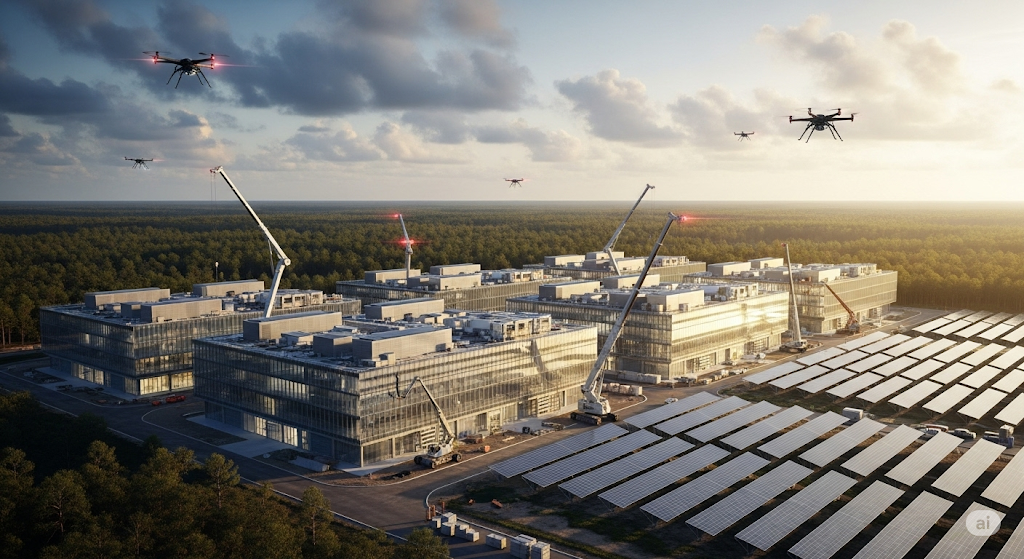
New Delhi, India — August 21, 2025— Louisiana has reached a major milestone in its journey toward becoming a digital infrastructure powerhouse. The Louisiana Public Service Commission (LPSC) approved Entergy Louisiana’s proposal to build new power facilities and transmission systems. This approval lays the foundation for Meta’s massive $10 billion data center in Richland Parish.
This facility will become Meta’s largest data center anywhere in the world. It will serve as a critical engine for its artificial intelligence operations and digital platforms. Meta announced the data center in December 2024 as part of the company’s global expansion. The aim is to support rising demand for AI-powered services and high-speed digital applications.
Entergy’s infrastructure proposal includes developing three natural gas-fueled power plants that will utilize combined-cycle combustion turbine (CCCT) technology. This advanced setup enables greater energy efficiency and fewer emissions. Entergy will build two of these power stations in Richland Parish and plans to have them operational by 2028. The company will construct the third plant at the Waterford site in St. Charles Parish, expecting it to come online by late 2029.
To accompany the generation facilities, Entergy received approval to construct new transmission lines. These lines will ensure consistent power delivery to the data center and enhance grid stability throughout the region. Entergy designed these lines to strengthen Louisiana’s energy resilience, benefiting both industrial operations and the local population.
The commission’s decision also greenlights a major renewable energy push. Entergy now has the authority to secure up to 1,500 megawatts of solar capacity. This effort will help meet Meta’s aggressive sustainability targets. Meta has long committed to running its data centers entirely on renewable energy. Therefore, this solar build-out will play a key role in achieving that ambition.
“This approval is more than just a green light for power plants,” said a spokesperson for the LPSC. “It signals that Louisiana is ready to lead the next wave of energy and technology integration.”
The collaboration is expected to generate substantial economic benefits for the state. Construction will create thousands of jobs during the building phase. Furthermore, long-term employment opportunities will arise once the center becomes operational. Local suppliers, contractors, and service providers will also benefit from Meta’s presence and infrastructure investment.
At the same time, the project reflects broader industry trends. As artificial intelligence becomes more central to tech operations, data centers consume skyrocketing amounts of electricity. National forecasts suggest that data center energy usage could triple by 2030. Machine learning, natural language processing, and other AI applications drive this growth.
In response, tech firms like Meta explore innovative energy partnerships, including potential future reliance on nuclear power. In fact, Meta has already begun evaluating proposals from nuclear developers to meet long-term, low-carbon energy needs.
Entergy’s proactive investment plan positions it as a key player in this new energy-tech frontier. The utility looks beyond traditional energy delivery models to serve the evolving demands of the digital age. By modernizing its grid and embracing hybrid generation sources, Entergy sets a new standard for utility engagement in tech-driven infrastructure.
According to a Reuters report, community stakeholders have largely welcomed the project. While some environmental and consumer groups raised concerns about fossil fuel use, Entergy emphasized that its gas-powered plants are temporary solutions on the road to a broader renewable mix.
Entergy also confirmed that Meta will cover expenses related to its specific energy needs. This arrangement protects residential and small business consumers from any potential rate hikes.
As construction begins, the tech and energy world will watch Richland Parish closely. The success of this venture could establish a scalable model for how utilities and tech companies can co-create sustainable, high-capacity power systems. Ultimately, these systems will serve both innovation and the environment.
About the Author