VR in Education
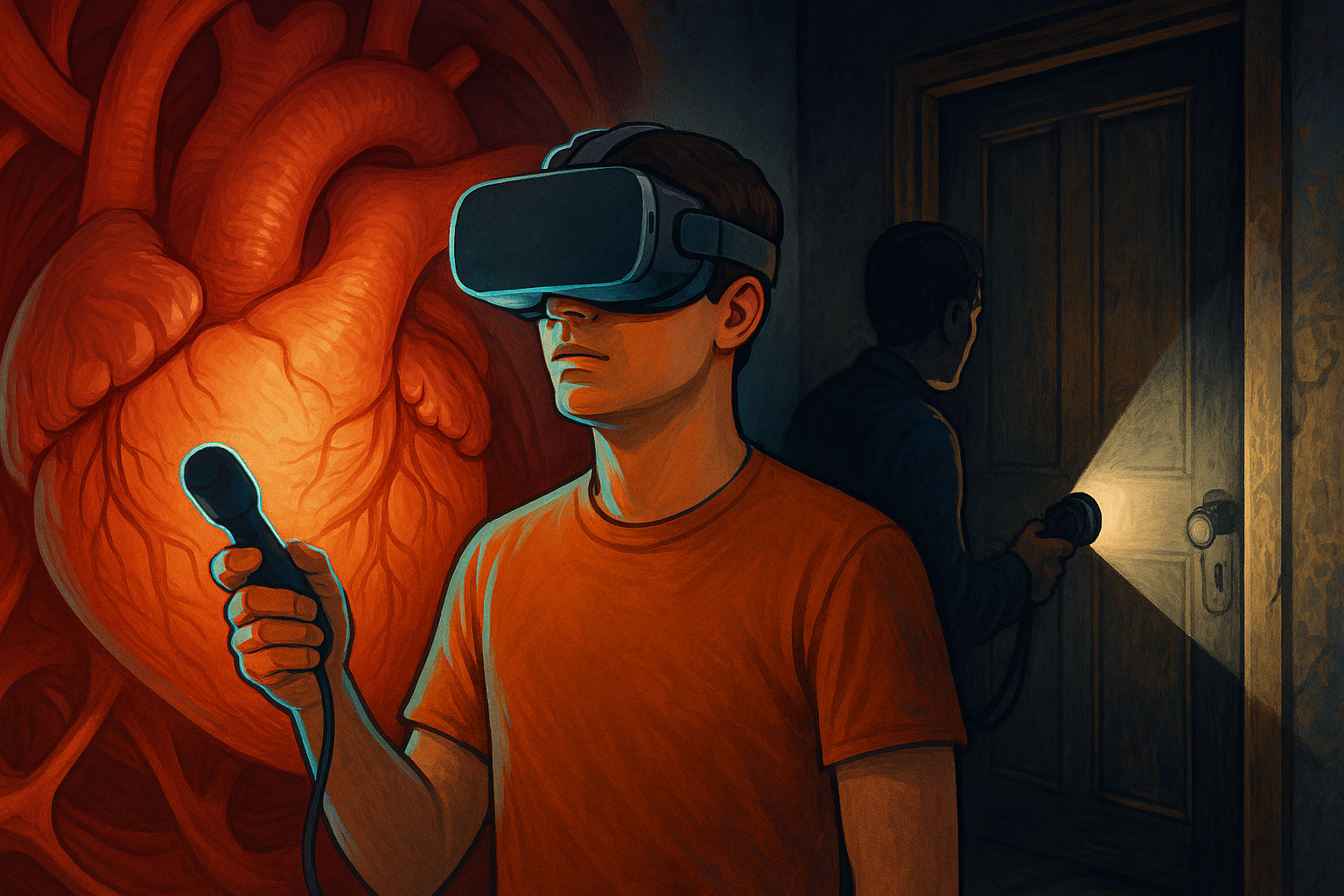
Picture this: you’re in a biology lab, and rather than seeing a sketch of the human heart, you’re actually within it, you’re seeing the valves open and shut like doors on a spaceship. Or you’re viewing a thriller, and rather than screaming “Don’t go in there!” at the screen, you’re the one with the flashlight, deciding whether or not to push open the terrifying door.
Welcome to the Virtual Reality world, where learning and storytelling are anything but passive; watching them is interactive, immersive, and unforgettable.
Learning Takes a Reality Check
Yes, traditional learning has its advantages; chalk, chat, and books have worked. But come on: reading facts out of a book is about as thrilling as observing paint dry in slow motion. Enter Virtual Reality, the rescuer of contemporary learning.
Immersive Learning Environments
Virtual Reality makes theoretical concepts into tangible experiences. Feeling like learning about the solar system? Wearing a headset, you’re gliding through space, avoiding asteroids and waving hello to Mars. Learning history? Experience the trenches of World War I or get a lecture from an imaginary Socrates.
This isn’t cool, it’s efficient. Studies indicate that Virtual Reality learning can increase retention rates by as much as 75%. And that’s because VR can engage more than one sense and then pin information to the back of your head like peanut butter to the ceiling.
VR enables students to rehearse high-risk maneuvers in a zero-risk setting. Medical students can rehearse virtual surgery, engineering students can simulate bridge design, and chemistry students can blend flammable chemicals without incinerating the lab (or their eyebrows).
And it’s economical. One Virtual Reality module can be shared by thousands of students worldwide and provide quality education to more individuals than ever before.
Breaking Barriers
Virtual Reality revolutionizes remote and disadvantaged communities. Headset and connectivity: students experience top-of-the-world lectures, museums, and labs, no plane ticket or passport needed. It’s leveling the playing field for entertainment, pixel by pixel.
Entertainment: The Story Swallows You Whole
If education is receiving a makeover, entertainment is witnessing a complete revolution. Virtual Reality storytelling isn’t viewing, it’s existing.
You’re Not Watching the Story, You’re Living It
Classic movies and novels transport you along with a story. VR places you in the middle of it. You’re not merely observing a detective crack a case; you’re hunting for clues yourself. You’re not merely observing a romance develop; you’re a participant in the love triangle (guilt-inducing, but exhilarating).
This change from passive to active participation redefines everything. It forms emotional investment, empathy, and the sense of agency that old media can’t manage.
VR allows you to tell the story from every conceivable perspective. Listen to the bad guy’s side of things? Walk a mile in his or her shoes. Hear the sidekick’s history? Go see it in an off-shoot scene. It’s like getting to read a novel where every character gets an entire chapter, and you get to decide which one to turn the page to next.
Remember those “Choose Your Own Adventure” books? VR takes that concept and cranks it into overdrive. Your decisions create the outcome. Help the hero or betray them. Explore the spooky mansion or run for it. Every choice spawns a new outcome, so every experience is unique.
The Tech That Makes It Tick
Behind the magic of VR is a blend of cutting-edge hardware and software. Headsets like Meta Quest, HTC Vive, and Apple Vision Pro offer high-resolution visuals, spatial audio, and motion tracking. Add haptic gloves, treadmills, and AI-driven environments, and you’ve got a recipe for full immersion.
Developers use 3D modeling, game engines like Unity and Unreal, and machine learning to create responsive, realistic worlds. The goal? Fool your brain into believing you’re somewhere else, and it works surprisingly well.
Challenges on the Road to VR Nirvana
Of course, VR isn’t all sunshine and simulated rainbows. There are hurdles:
- Cost: High-end VR gear can be pricey. Schools and creators need funding to make it widely accessible.
- Motion Sickness: Not all stomachs like virtual rollercoasters. They’re ironing out the creation process, but it still exists.
- Content Quality: A poorly constructed VR experience can shatter immersion quicker than a buffering YouTube clip. Solid UX design and narrative are important.
In spite of these issues, the field is changing fast. Cheap headsets, improved graphics, and smart software are making VR go mainstream day by day.
Real-World Examples That Inspire
- Stanford’s Virtual Heart Project: Future doctors learn a beating heart in 3D, anatomy impossible to teach with textbooks.
- Anne Frank House VR Tour: Visitors tour through the secret annex, living history with emotional resonance and compassion.
- Tilt Brush by Google: Artists paint in 3D space, painting interactive sculptures and worlds that break free from the rules of traditional canvas boundaries.
These aren’t tech demos, they’re evidence that VR can teach, inspire, and change.
The Future: Smarter, Deeper, More Connected
VR will continue to get even more powerful in the future:
- AI Tutors: Learning experiences that learn about your learning style and pace.
- Hyper-Realistic Worlds: Virtual worlds with simulated real-world physics, weather cycles, and even social norms.
- Global Classrooms: Students from all over the world learning together in virtual classrooms that erase cultural and geographical barriers.
In recreation, you’ll experience full-motion VR movies, live theatre that you can interact with, and concerts where you can dance with your favorite musician, without fear of treading on toes.
Final Thoughts: The Power of Presence
VR is not a technology; it’s an entry. It’s changing the learning experience, the storytelling experience, and the way we engage with ideas and emotions. If you’re a student sick of textbooks or a novelist who needs to destroy the fourth wall, VR provides a new border. A place where the classroom has no boundaries, and the story doesn’t.
So next time someone says “put on your thinking cap,” maybe suggest a VR headset instead.
About the Author